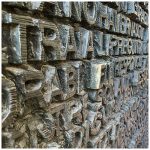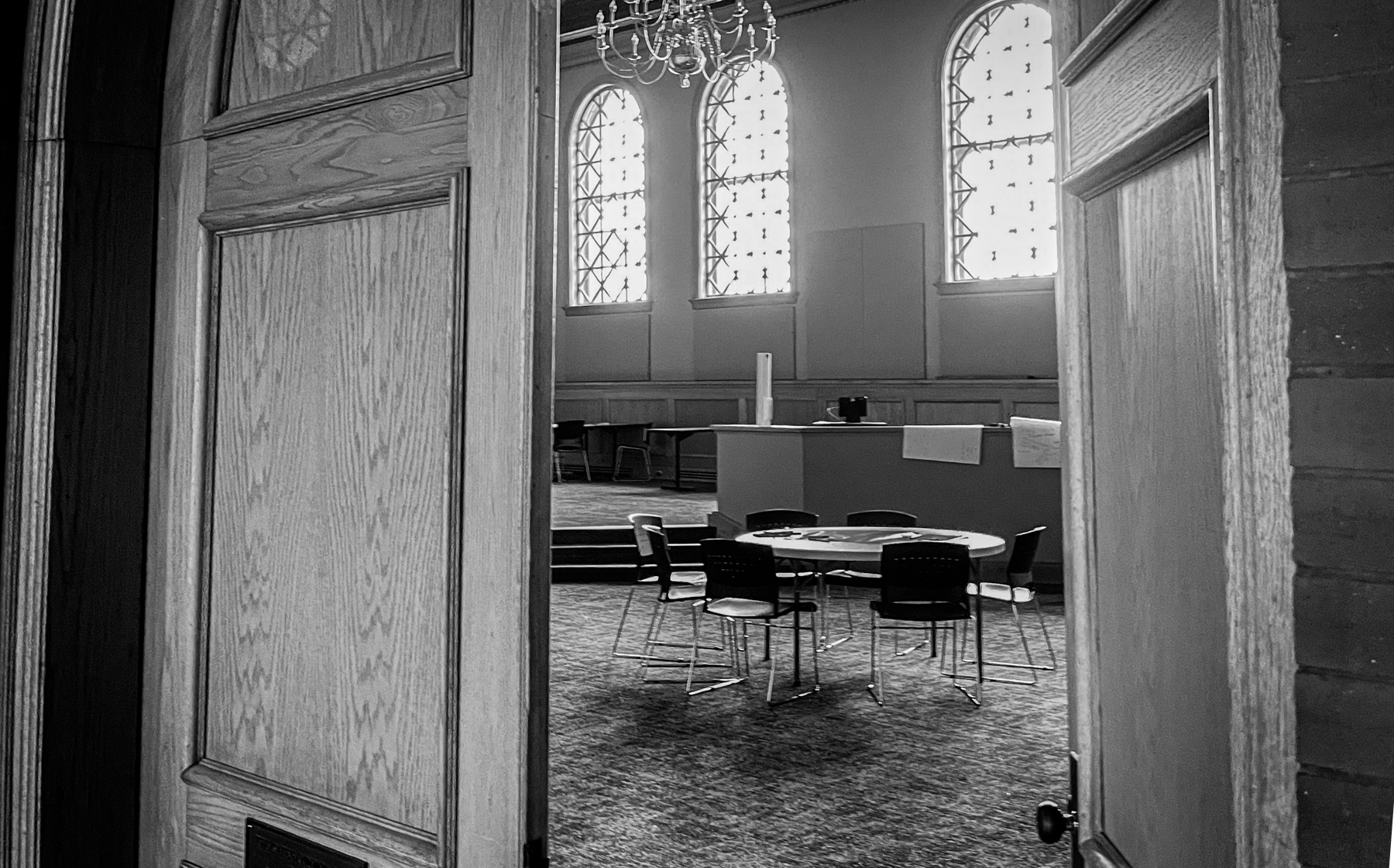
A hunt for a quiet interview space on Hope’s college campus led by chance to this room. Toward the end of the interview, Hope shared that this was the first time she’d seen the door open all year. Her high school class stored their belongings here during their graduation ceremony. This is where she’d last seen Habiba before Habiba was detained. “Last semester, I would walk past here every day on the way to class,” Hope said in late April. “I had this feeling that, she’s just in there behind a locked door in that beautiful, beautiful red dress that she was wearing at graduation. I’m walking past it every day, [but] there’s nothing that I can do because it’s a locked door.” In poignant symbolism, Habiba has just been released from detainment, and this door has been found unlocked. Photo by Kami Rice.
ARTICLE BY KAMI L. RICE
The night of April 25 was cold in Centennial, Colorado. Temperatures after 10 p.m. had dropped to around 40 degrees (4 degrees Celsius). In the light of streetlamps, a bundled-up group of nearly 30 people armed with blankets stood or knelt quietly on the sidewalk edging the U.S. Immigration and Customs Enforcement facility’s parking lot.
The blankets weren’t for themselves. They were for their friends, Hayam El Gamal and her five children, then aged 5-18, who would soon exit the facility. The evening vigil marked the end of a dramatic Saturday during which Hayam’s family had been unexpectedly re-detained in the morning, forced to board a plane, and nearly deported.
To the relief of the Colorado Springs community the El Gamal family had lived in since arriving in the U.S. in 2022 on tourist visas, two days earlier a federal judge had ordered that Hayam and her children be released from the Dilley, Texas, detention center where the family had been held for nearly 11 months. Colorado friends traveled to Texas to make the long drive back home with the family, arriving in the wee hours of Friday night, April 24.
While the community knew the family’s immigration journey wasn’t over—Hayam and her oldest, Habiba, would be wearing ankle monitors as their asylum case continued to be processed—by Saturday morning, community members began to feel relief and texted about celebrating the family’s hard-won release from detention and the legal protection they now had. The community, thus, wasn’t feeling too worried about the family’s obligatory check-in at ICE early on Saturday.
Upon the family’s arrival at the Centennial facility, smiling ICE officers told them their appointment would last five minutes and that they would be on their way home soon, their lawyer Eric Lee detailed on X. Instead, ICE rushed the six of them to the Denver airport and onto a waiting plane that was soon flying east, heading out of U.S. airspace.
Celebrations paused, and the Colorado community again sprang into action, as they had been doing for months. Within an hour, they organized a press conference to alert the media to the re-detainment, while lawyers worked to secure a stay on the family’s deportation.
And the efforts worked. This time. The plane carrying the El Gamals out of the U.S. turned around and brought them back to Colorado by Saturday night to the waiting arms and blankets of their community.
Upon the family’s arrival at the Centennial facility, smiling ICE officers told them their appointment would last five minutes and that they would be on their way home soon, according to their lawyer Eric Lee.
Tragedy Follows Graduation Day
Hope’s freshman year of college was marred by worry over her friend Habiba. Three days after Hope and Habiba’s high school graduation last year came the shocking events of June 1, 2025, that upended Hope’s friend’s promising transition to college.
At a Jewish community demonstration in Boulder, Colorado, calling for the release of Israeli hostages held by Hamas in Gaza, Habiba’s dad, Mohamed Sabry Soliman, attacked peaceful demonstrators with a homemade flamethrower and Molotov cocktails. More than a dozen people were injured and an 82-year-old woman succumbed to her injuries. Last month, Mohamed Soliman pleaded guilty to 101 state charges and was sentenced to life in prison. The federal government may yet seek the death penalty for his federal charges.
Although numerous media outlets have reported that FBI investigators found no evidence that Soliman’s now-ex-wife and children were involved or had knowledge of his plan, these six family members were detained by ICE on June 3, 2025. Egyptian nationals who lived in Kuwait before coming to the U.S., they were legally present in the U.S. due to pending asylum cases at the time of Soliman’s attack.
The family has condemned Soliman’s actions in interviews and statements. “We believe that what happened to the victims of the attack is dreadful,” Habiba wrote in January. “What my father did goes against everything me and my family believe in. If I had known, I would have definitely tried to stop him.”
Hope first bonded with Habiba in chemistry class. Habiba started their sophomore year a couple of weeks late and needed to catch up. “What’s a girl to do but give her chemistry notes?” Hope said, chuckling. The two shared other classes, too, and soon did everything together at school.
When Habiba and her family were detained, Hope says her friend’s situation quickly dominated the story for her: “My friend is being held by ICE, and my friend hasn’t done anything wrong. She’s being punished for the crimes of her absent father.”
At college last fall, news reports were Hope’s only source of updates about Habiba. To describe her despair, Hope ruefully talks of drowning her sorrows alone in her dorm room with a pint of strawberry ice cream. It wasn’t until earlier this year that Hope connected to the community of people advocating for her friend’s family—which changed the story for Hope.
“My friend is being held by ICE, and my friend hasn’t done anything wrong. She’s being punished for the crimes of her absent father.”
-HOPE
“I just felt so unspeakably alone and so helpless,” Hope said of the first months of Habiba’s detainment. “The really important thing about having a community that gets together is that none of us feel alone. And in having just someone by your side, then all of a sudden, we all feel like, ‘Hey, we can do something. Hey, there’s hope. We’re not helpless anymore.’”
Art instructor Mariah Ziemer taught art to Hope as well as the El Gamal kids. She and Hope together describe how personal other immigration and detention stories have become for them after their connection to this case. For Hope, other deportation stories, too, now represent “a real person with a real story. And a real family. And real physics projects that they’ve done. And real fancy scholarships from the local news.”
Mariah says that through the process of supporting the El Gamal family, she is convicted to be a more informed American citizen. While she’s previously been generally informed, she had never before called her senators. She hadn’t previously looked at headlines from different news outlets to intentionally consider different perspectives on a key issue as she does now.
A 16-year-old Is Fired Up
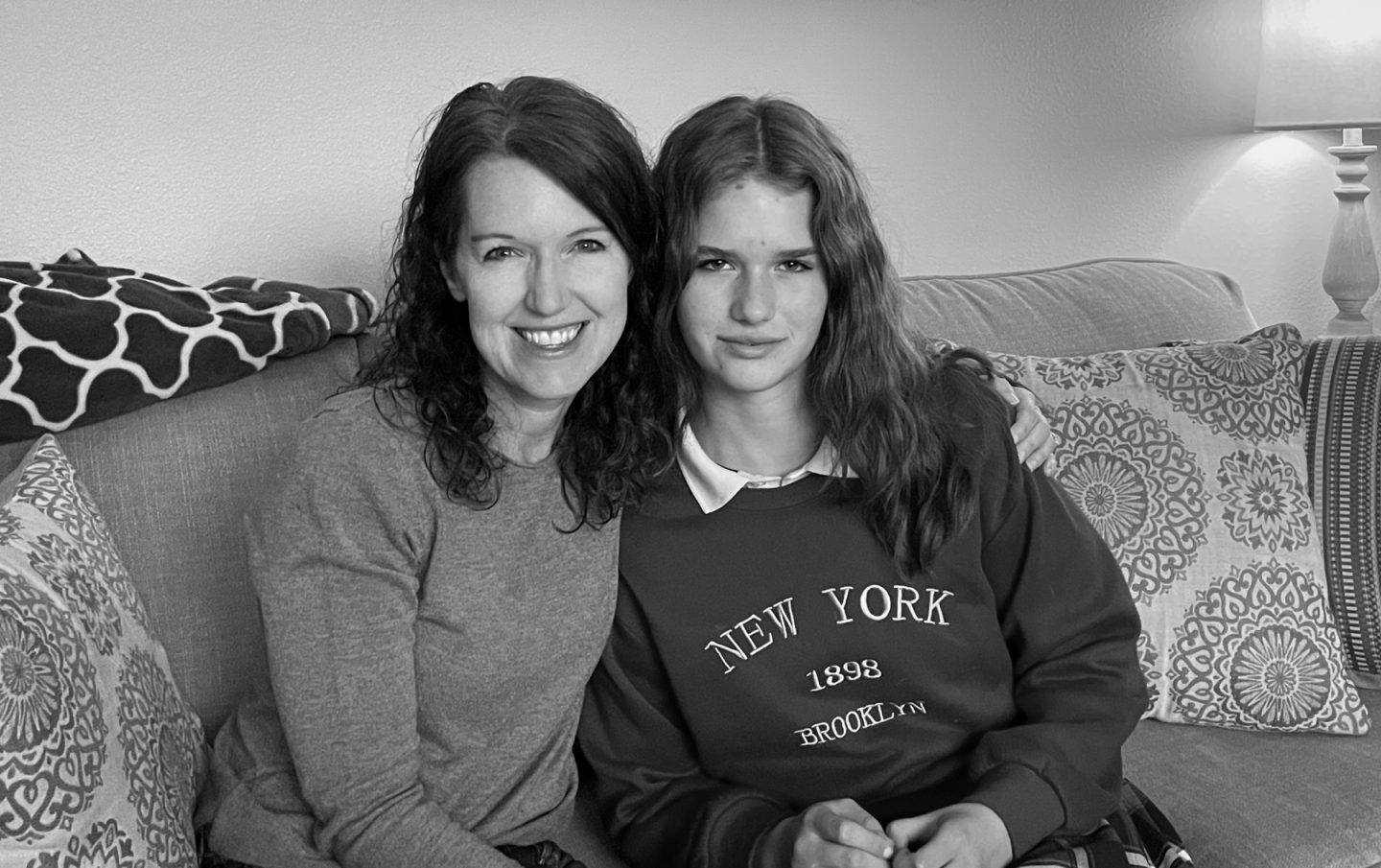
Rebecca and Renea Hopkins. Photo by Kami Rice.
Renea Hopkins is seated on her family’s tan couch with her mother, Rebecca. Renea, who is wrapping up her sophomore year of high school, is quiet yet confident as she speaks about her classmate, Hayam El Gamal’s 16-year-old son. She describes him as a funny, bright kid from seventh- and eighth-grade orchestra class whose siblings she’d see in their school’s hallway. “You could just tell his heart,” Renea said.
Despite her reserved manner of speaking, Renea expresses deep feeling as she describes being fired up and frustrated over her friend’s family’s situation. She feels protective of the family, and a justice issue has become personal. “It gets me so mad that this amazing family, so kind, was just so wronged.”
The Hopkins family spent Renea’s childhood years as Christian missionaries in Indonesia, home to the world’s largest Muslim population.
“Since I grew up in a mostly Muslim place, somewhere where we’re not the same ethnicity, I feel pretty sensitive about this whole immigration thing,” she said. “[The El Gamals] are not bad people at all. They should not be in a detention center. They did nothing wrong…The government didn’t have any reason to keep them there.”
The cold April night the El Gamal family was re-released from ICE detainment, Renea’s classmate had the presence of mind to pause before climbing into a waiting vehicle with his family. Even after he’d spent the day flying across the U.S. and back again under duress, he smiled widely and gave an impromptu speech of thanks to the little crowd gathered in Centennial on his family’s behalf.
Renea said this is consistent with his character: “He will always show you his gratitude. He will always be that person to just be super grateful, like, let you know how much you helped him.”
“Since I grew up in a mostly Muslim place, somewhere where we’re not the same ethnicity, I feel pretty sensitive about this whole immigration thing.”
-RENEA
When ‘United Despite Differences’ Isn’t a Cliché
Rebecca Hopkins acknowledges she felt shaken when she first heard news of the attack in Boulder, two hours north of Colorado Springs. She recounts her first thoughts: There was a dad in our very tight-knit community who just killed someone and injured other people like a terrorist? There was a terrorist in our midst? Are my kids safe? What does this mean?
Then she thought of the family in their midst, the family who had fully cooperated with the investigation and assisted authorities but had still been detained. She wondered what could be done for them. It turns out a lot of people in the community were asking that question, and gradually they found each other. The effort started with parents and teachers from the El Gamal kids’ school, many of whom belong to the same church. Some of them formalized their effort by creating a group called Neighbors of Faith and Conviction.
Yet the community effort expanded well beyond people affiliated with any one faith tradition. In mid-May, the group Jews for Due Process held a special Jewish ritual and rally in Colorado Springs advocating for due process for the El Gamal family. Acknowledging the father’s horrific crime, the group wrote in their statement, “We condemn and mourn that horrible violence and the ongoing harm it caused. We also condemn collective punishment as both counter to our Jewish values and to our American ones.”
The El Gamals’ supporters’ activities have ranged from press conferences to organizing visits to the family in Texas. They’ve provided water to each other at gatherings and sought meetings with their U.S. Representative Jeff Crank. When meetings with him weren’t forthcoming, they met with a senior staffer in his district office and took up a presence of prayer. A confidential Signal coordination group has over 40 members, and an email list for getting the word out through Neighbors of Faith and Conviction is much larger.
Members of the community effort don’t sit in any one political sphere. Instead, they’ve united around trying to be good Americans and good neighbors, responding as they see the abuses of a system that is “going wrong and too far,” says Rebecca. Renea says she and her fellow teenagers aren’t super political. Her friends just “hear about the family, and they are like, ‘Oh yeah, that’s not right!’” They don’t even talk about the politics of the situation, she says.
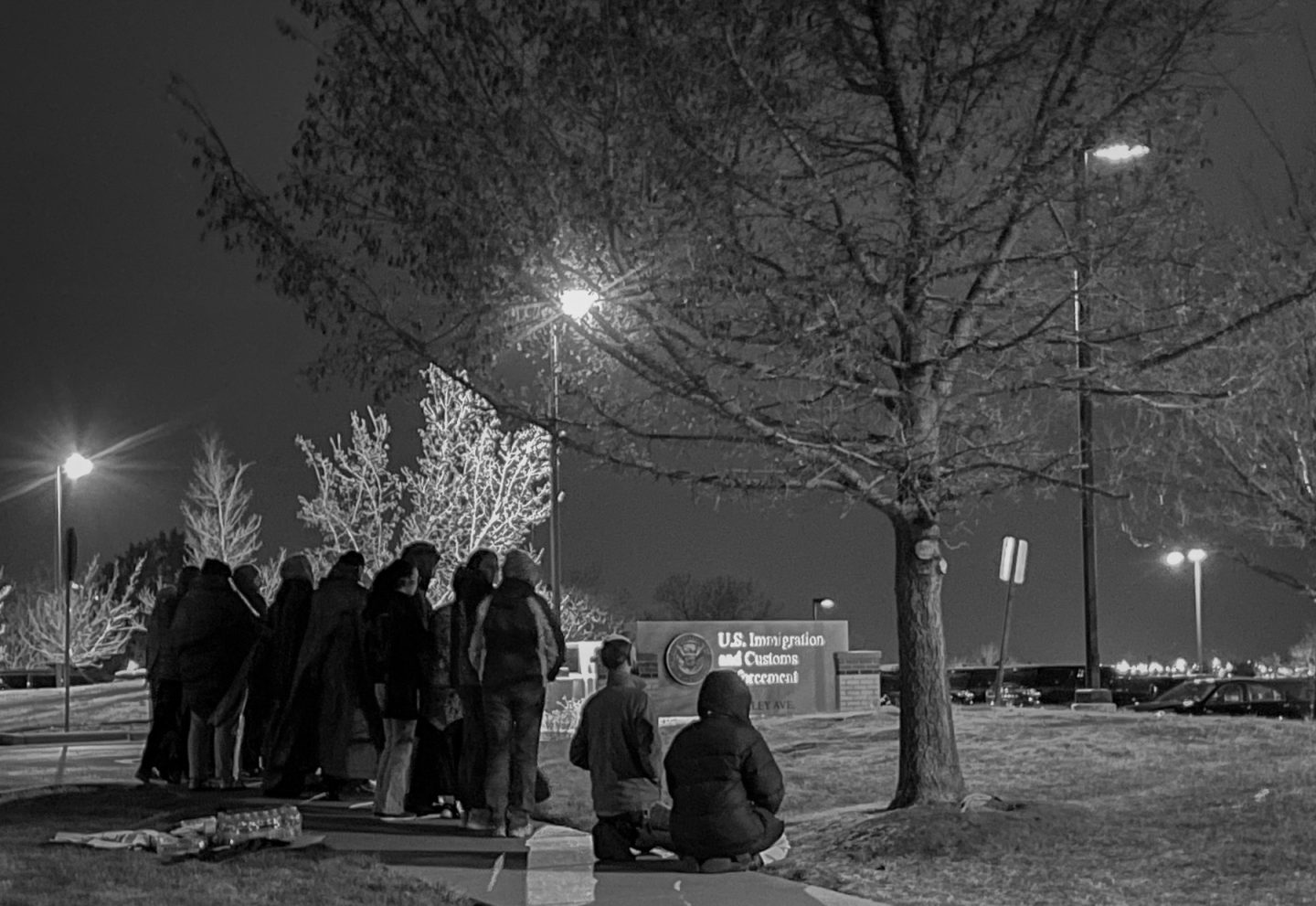
On April 25, the El Gamals’ friends waited for them to be released from the ICE building in Centennial, Colorado. Photo by Kami Rice.
With her teacher hat on, Mariah has seen how important community action is for all the students who are part of this story as they observe how the grownups are responding. “Even if they can’t necessarily grasp the complexity of these issues, they certainly feel and know deep in their bones that something is wrong and something is not right,” Mariah said.
The students, she says, are watching to see whether the adults are going to fight fire with fire. “Or are [the adults] going to fervently, passionately advocate their case and the message they want to promote and do it peacefully, in a way that really dignifies the conversation as well as the people involved, coming from a place of love and compassion and mutual respect even amidst incredible disagreement?”
In that vein, Rebecca says it’s been powerful to do this advocacy alongside her daughter and see Renea find her own voice, to see this shape her. “I love it. I love doing this with her. It’s been really, really special.”
Another powerful experience for Rebecca came in January as the community group planned their first press conference. Habiba, who turned 18 shortly after she was taken into federal custody in June 2025, had issued a statement from the Texas detention facility, which the group would share with the press. Habiba described things happening inside the detention center that contradicted the U.S. government’s narrative.
As community group participants debated whether to use their full names during the press conference, they realized that if Habiba Soliman could speak under her own name, despite the possibility of government retribution in detention, they could too. “A teenager was leading the way and giving us courage and helping us find our voices,” Rebecca said.
“We condemn and mourn that horrible violence and the ongoing harm it caused. We also condemn collective punishment as both counter to our Jewish values and to our American ones.”
– JEWS FOR DUE PROCESS
Dealing with Hateful Rhetoric About Your Friends
In April, shortly before the family was released, Hope visited Habiba in the Texas detention center. Even there, Hope said, the El Gamals tried to be super hospitable, treating their visitors like they were guests in their home. She described the vending machine food—the only available option—her group offered the El Gamals, knowing their detention food had been limited. Yet, the El Gamals first offered the snacks back to their visitors.
“It’s just mind-blowing how kind they are,” Hope said. “They’ve always been just that kind, and I think that’s why our community is so strong.”
Going through security to enter the Dilley Center, Hope experienced a little of the dehumanization her friend had been living under. She and Habiba talked about how, in the face of being dehumanized and treated without compassion, the impulse is to dehumanize back. The 18-year-olds discussed the important mental battle of refusing to sink to that level and of instead staying kind.
The same extends to those posting hateful social media comments about the El Gamal family. “They haven’t met my friend or her lovely little siblings, so I’m just giving them the benefit of the doubt. But it’s so hard,” Hope said. “But if Habiba could stay kind in there and not dehumanize the guards who are bullying her baby siblings, then I can stay kind out here, and I can not start leaving hate comments on the hate comments.”
Mariah noted that her faith background teaches people to love your neighbor and your enemy at the same time, but it’s hard to practice this when people say terrible things about your friends. “But as Hope said, for a family like this to exemplify that [when] they have undergone that level of sustained trauma and suffering? [It’s] an example I can follow as well.”
All of Rebecca Hopkin’s children were born while they lived in Indonesia, and Rebecca’s view of community was positively shaped by her hospitable Muslim community as she raised her kids. “There were times when Muslim neighbors really advocated for us. They took care of us,” she said. One example of this care came when the Hopkins family was new to the community. Rebecca’s husband became critically ill with dengue fever. Even though the family was not yet well known, their neighbors opened their hearts to assist the Hopkins.
“Because I know what it felt like to be the minority religion [entering] into a Muslim country and felt very safe and welcome there, I want to return that,” Rebecca said. She feels protective toward Muslims trying to integrate into America. She wants to “expand the conversation around Muslims, that not all Muslims are terrorists. They’re not all extremists. Most of them are just trying to make a living for their family and get their kids through school. We have so many similarities [and Muslims are] great to connect with and build community with.”
“It’s so hard…But if Habiba could stay kind in there and not dehumanize the guards who are bullying her baby siblings, then I can stay kind out here and I can not start leaving hate comments on the hate comments.”
– HOPE
In a Good Expression of Community, Everyone Gives, Everyone Receives
Despite the strength Habiba has shown and the way she’s led her community even from behind detention walls, in a June 4 post-detainment statement, marking a year since her family’s arrest, Habiba, who has since turned 19, expresses the toll this year has taken on them and what a difference their community has made.
“I always knew we were surrounded by amazing people, but to see everyone come together in this hardship is incredible,” she wrote. “People lined up to help us even if they didn’t know us personally. This hardship helped us see the true faces of the people around us. Someone was always checking if we needed anything and instantly taking care of it.
“They are the reason that we still have any power to push forward. ICE tried to isolate us, but it didn’t matter. People came to stand in front of the ICE office for hours, just for us.”
Hoping that good things will come out of the hardship they’re living, Habiba wrote of her family, “As long as we are together and as long as we are surrounded by a wonderful community, we are going to get through it.”
“We’re not the heroes in this,” said Rebecca, speaking of the group that’s been advocating so actively on the family’s behalf. “We’re just the community, and they’re the community too. They started this whole thing and showed us the way.”
“As long as we are together and as long as we are surrounded by a wonderful community,
we are going to get through it.”
-HABIBA
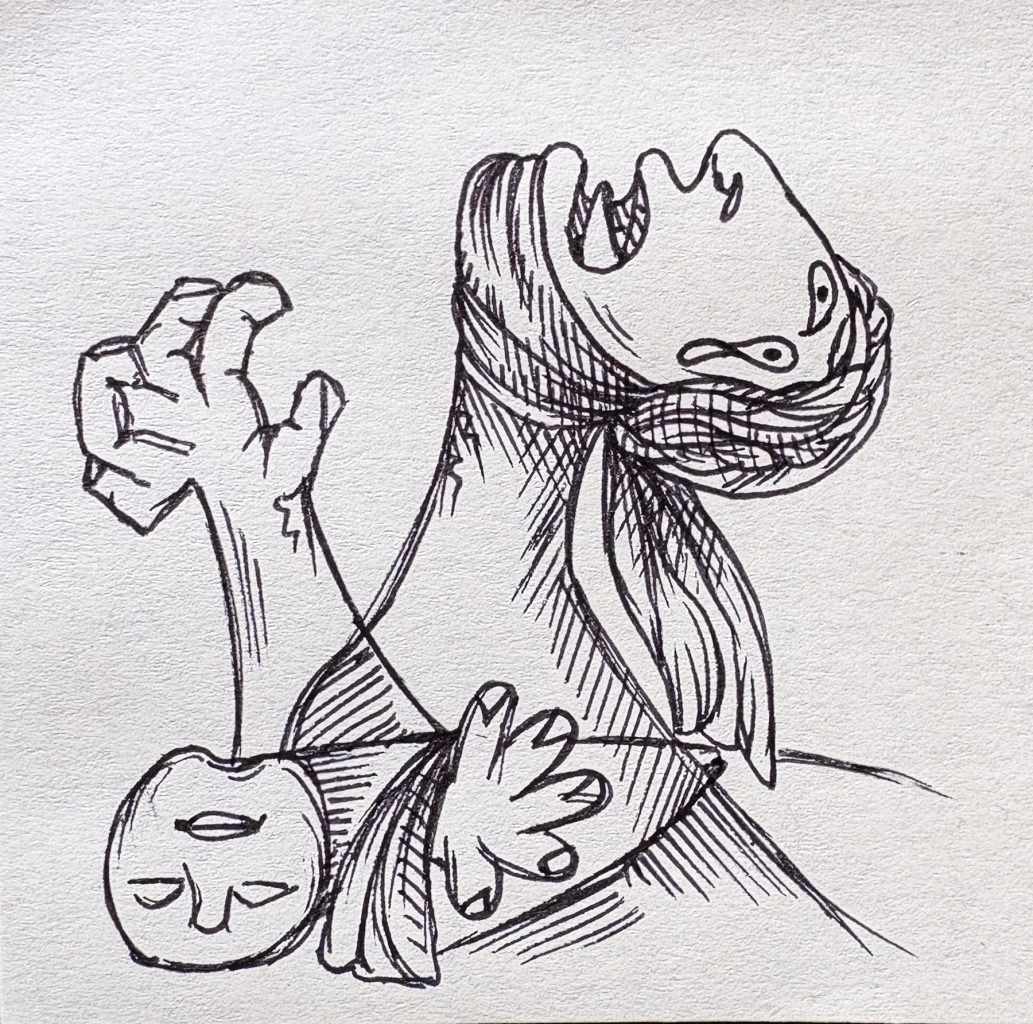
Sketch by Mariah Ziemer, referencing Picasso’s “Guernica.”
This doodle is based on a portion of Pablo Picasso’s Guernica, painted in 1937 after the Basque town of Guernica was tragically bombed during the Spanish Civil War. As I reflected on the El Gamal family being detained, I couldn’t erase the image from my mind of the mother crying out over her child, who lies limp in her arms, shown in the lower left corner of Picasso’s mural. Though the painting’s original story and cultural context differ from my own and that of the El Gamal family, I see and feel common threads of suffering and grief, all framed by the ever-pressing question, “Why?”
I also drew this new design on a sticky note because I was inspired by Habiba, who once placed sticky notes on each of her classmates’ lockers with encouraging, hand-written notes.
-MARIAH ZIEMER
Kami L. Rice
Kami Rice, Anthrow Circus’s editor, plies her insatiable curiosity from a base in northern France and from perches in coffeehouses, cafés, and friends' homes the world over. As a freelance journalist, she has reported for the Washington Post, The Telegraph, The Tennessean, The Bulwark, and Christianity Today, among many others. Her more creative work has appeared in Another Chicago Magazine, The High Calling,and Washington Institute's Missio.Her French to English translation has been published by Éditions Beaux-Arts de Paris. She also edits manuscripts and articles for a variety of clients and loves learning about the lives of regular, real people wherever she finds herself.