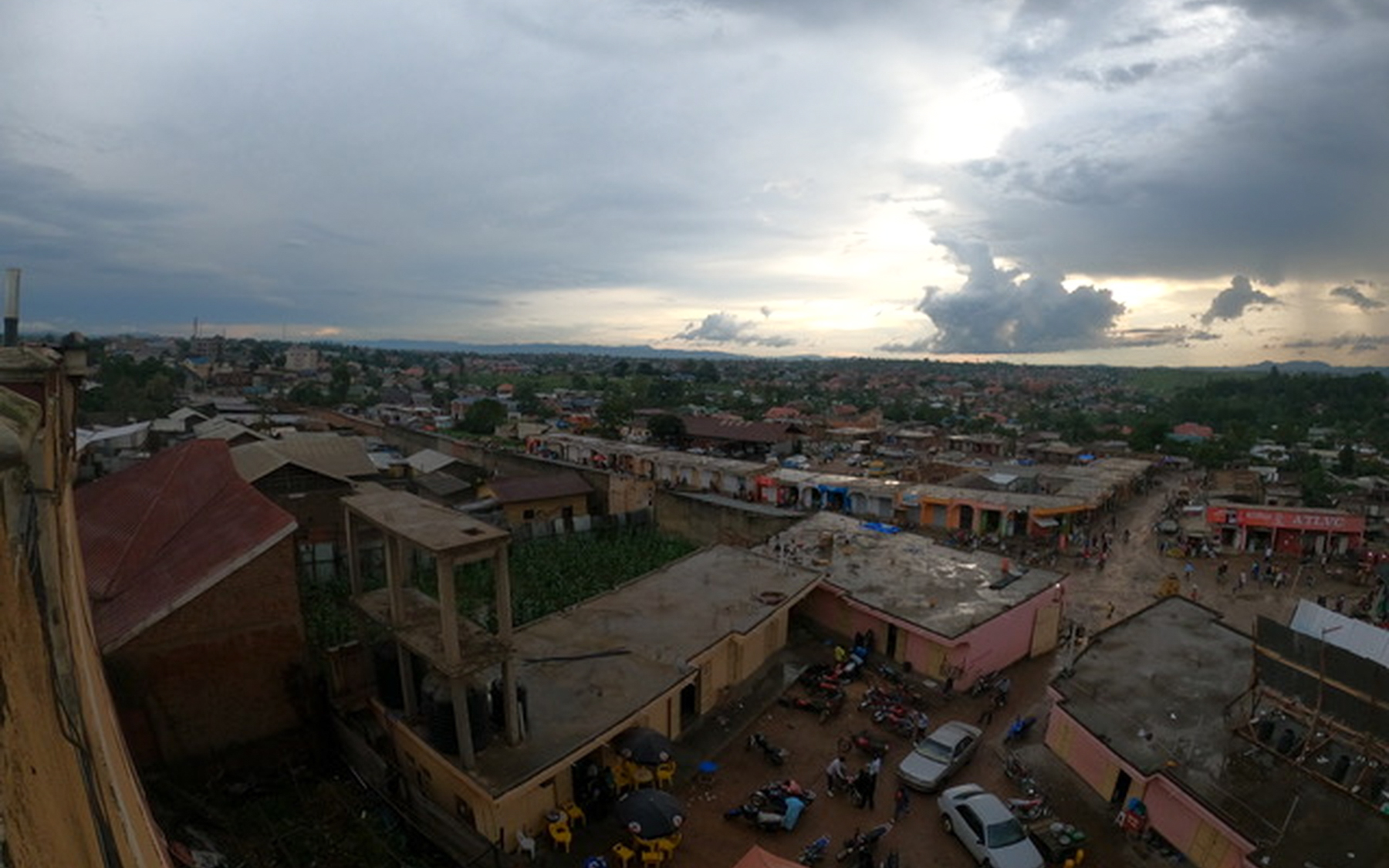
An early morning view of Bunia. Photo by AJ Johnson.
BY AJ JOHNSON
The thermometer still beeped.
Near an eastern border crossing of the Democratic Republic of Congo, travelers stepped down from buses carrying sacks of cassava, yellow cooking-oil containers, and plastic bags tied with string. Children leaned against parents, half asleep in the afternoon heat. A woman adjusted a bundle on her back. A man wiped dust from his forehead before joining the line.
One by one, health workers lifted infrared scanners toward faces and waited for numbers to appear.
The ritual looked simple: Stop, scan, move. But behind it stood a system most people rarely see. Surveillance officers reporting unusual illnesses. Community health workers following rumors of sudden deaths. Motorcycles carrying blood samples from villages to laboratories. Contact tracers calling families and neighbors. Pastors and local leaders repeating health messages in churches, markets, and burial gatherings.
When the system works, viruses are contained before most people even know of an outbreak or encroaching epidemic.
When it weakens, a fever at a border post can become a warning that arrives too late.
The Ebola outbreak now spreading through the Congo and Uganda is testing more than emergency medicine. It is testing the quiet public health infrastructure built over years with help from international donors, including the United States. After the U.S. Agency for International Development was dismantled in 2025, forcing broad reductions in foreign aid and aid for external health, health workers are asking whether the alarms built after earlier outbreaks can still sound loud enough and fast enough.
On May 16, the World Health Organization determined that the Ebola outbreak in the Congo and Uganda constituted a Public Health Emergency of International Concern. The first confirmed patient with Ebola had the rare Bundibugyo species of the virus, for which there is no approved vaccine or specific treatment. By mid-May, the agency reported eight laboratory-confirmed cases, 246 suspected cases, and 80 suspected deaths in Ituri Province, including Bunia, Rwampara, and Mongbwalu. Uganda had confirmed two cases among people who had traveled from the Congo.
WHO said several factors made the outbreak extraordinary: clusters of unexplained community deaths, infections among healthcare workers, uncertainty about the true spread, high mobility, insecurity, informal health facilities, and the absence of approved vaccines or therapeutics for the Bundibugyo strain.
Within days, the numbers climbed. As Reuters reported on May 23, the Congo had nearly 750 suspected cases and 177 suspected deaths, while Uganda confirmed three additional cases, bringing its total to five. The Ugandan cases included a driver who transported the first confirmed patient and a health worker who treated that person. Both were identified through contact tracing, one of the systems that still appeared to be working in places.
That is the paradox of the current outbreak. The warning system has not disappeared. But it is under pressure.
USAID cuts damaged epidemic preparedness and hampered the Congo’s Ebola response…“The actors who once ensured epidemic preparedness … are now absent or paralyzed.”
In Bunia, as The Guardian reported, health workers and aid organizations described facilities filling quickly. Trish Newport, an emergency program manager with Médecins Sans Frontières, said an MSF team searching for isolation space heard the same answer from every facility they called: “We’re full of suspect cases.”
Dr. Richard Kojan, an intensive care clinician with ALIMA who worked in several previous Ebola responses, was more blunt: “The outbreak is out of control.”
With no licensed vaccine or targeted treatment for the Bundibugyo strain, Kojan said the response depends heavily on speed: early detection, isolation, supportive care, contact tracing, safe burials, infection prevention, laboratory confirmation, and community trust. In outbreaks like this, speed is essential. The faster a case is detected, isolated, and supported, the better the odds of survival and containment.
WHO describes Ebola response as a chain of linked actions: disease detection, community engagement, contact tracing, laboratory services, infection control, logistics, safe and dignified burials, training, and case management. When one link weakens, the whole response slows.
That is why the timing of this outbreak has alarmed global health experts.
The health and medicine news site STAT reported that USAID cuts damaged epidemic preparedness and hampered the Congo’s Ebola response. Programs meant to detect cases, alert communities, dispatch response kits, build supply chains, and support local health systems were reduced, eliminated, or frozen. One person who lost a public health job after the cuts described a silent but dangerous drift in the region. “The actors who once ensured epidemic preparedness … are now absent or paralyzed,” the former public health worker said.
The International Rescue Committee said that after U.S. cuts, it reduced programming from five areas to two in the region now at the heart of the outbreak. Heather Reoch Kerr, IRC’s country director for the Congo, warned that recent reductions left health facilities without enough protective equipment, surveillance capacity, or front-line support to respond quickly and safely.
The scale of the reductions has been stark. STAT reported that U.S. Department of Health and Human Services foreign aid to the Congo fell from nearly $33 million in fiscal year 2024 to less than $10 million in 2025, while the USAID’s foreign aid to the country dropped from nearly $1.2 billion in fiscal year 2024 to $715 million in fiscal year 2025, then to $67 million in the final three months of 2025.
The Guardian reported a similar collapse in broader U.S. assistance, citing foreign assistance data showing U.S. support to the Congo dropping from $1.4 billion in 2024 to $431 million in 2025, and only $21 million so far in 2026. Assistance to Uganda also fell sharply.
A country does not simply lose money when health funding disappears. It can lose memory.
For African researchers, the uncertainty is not only financial. It changes what institutions are willing to attempt.
“Several African institutions are becoming more cautious about launching new projects, especially those that require expensive equipment, major investments, or international partnerships,” said Dr. Paka Essodolom, a research officer in biochemistry, nutrition, and food technology at the Togolese Institute of Agronomic Research.
For Essodolom, the risk is not abstract. Funding uncertainty slows the acquisition of laboratory equipment, field activities, technical training, scientific partnerships, and the importation of consumables and supplies. In an outbreak, those delays matter. A missing reagent can delay a test. Delayed training can leave a team unprepared. A postponed partnership can weaken the scientific networks that allow countries to respond faster.
“It is also pushing African researchers to seek greater autonomy and more local solutions,” Essodolom said.
But local capacity cannot be built overnight, especially during an emergency. Laboratories need equipment, trained personnel, reliable supply chains, maintenance contracts, reagents, fuel, data systems, and time. Surveillance depends on people who know where to listen and how to move information quickly.
A country does not simply lose money when health funding disappears. It can lose memory.
That memory was built through painful experience. The Congo has encountered Ebola viruses repeatedly. Uganda has its own long record of outbreak response. Health workers in both countries know what can happen when families hide symptoms, when clinics lack protective equipment, when a burial takes place before responders arrive, or when communities conclude that outsiders have come to control them rather than to help them.
In the current outbreak, fear has fed the transmission. As AP News reported, a treatment center in Rwampara was set on fire after authorities refused to release a victim’s body for family burial. In Mongbwalu, another treatment center operated by Doctors Without Borders was attacked and set ablaze, and suspected patients fled.
These scenes reveal why public health is not only technical. It is relational.
Burial is a family’s duty, a cultural memory, and spiritual care, but Ebola spreads through bodily fluids and contaminated materials. Ebola victims’ bodies can be highly infectious, making safe and dignified burials essential. Yet a response that ignores grief can produce resistance. A warning that arrives without trusted messengers can sound like an accusation.
That is where churches and faith-based organizations often become part of the public health infrastructure.
Across sub-Saharan Africa, Christian hospitals, clinics, pastors, and church networks frequently serve communities where public systems remain limited. In Ebola responses, they can explain why a burial must be handled differently, encourage families to report symptoms early, counter rumors, and help frightened communities hear public health messages without feeling abandoned.
This is the hidden architecture of outbreak control. It is not dramatic until it fails.
The work can be dangerous. As Reuters reported, three Red Cross volunteers died, likely after contracting Ebola while handling bodies in Mongbwalu before the outbreak was officially identified.
The deaths underline a hard truth: the people closest to the first alarms often carry the greatest risk.
On paper, epidemic responses can look like a checklist: Surveillance. Testing. Isolation. Contact tracing. Risk communication. Safe burials. Border screening. Supplies. Coordination.
On the ground, it looks more fragile.
A health worker waits for a test result while the waiting area fills. A driver carries a patient across districts before anyone knows the diagnosis. A nurse treats a fever that could be malaria, typhoid, or Ebola. A pastor hears rumors spreading through a congregation before official messages arrive. A laboratory waits for supplies. A volunteer prepares for a burial, knowing that compassion itself can become dangerous without protection.
This is the hidden architecture of outbreak control. It is not dramatic until it fails.
For years, international health initiatives helped strengthen parts of that architecture. USAID programs supported surveillance systems, emergency management structures, laboratory capacity, epidemiology training, community health, supply chains, and cross-border response. Some of that work was invisible by design. If samples moved, if alerts reached the right office, if a contact tracer arrived on time, the public did not need to be alarmed.
On May 23, as Uganda confirmed more cases linked to the Congo, contact tracing showed both the strength and the vulnerability of the system. A driver and a health worker were found because someone followed the chain of exposure. A Congolese woman who traveled from Arua to Entebbe and back to the Congo was detected after a tip-off from a pilot involved in her transport.
In other words, the alarms still sound.
The question is whether enough people remain in place to hear them, answer them, and act before the next traveler crosses the next border.
At the border post, the line keeps moving. A child rubs her eyes. A man shifts a sack from one shoulder to another. The health worker raises the scanner again. The number appears.
For a moment, everyone waits.
Then the next traveler steps forward.
AJ Johnson
AJ Johnson is a freelance photojournalist and faith-based storyteller with over 10 years of experience reporting on culture, Christianity, and social change across sub-Saharan Africa. A trained sociologist, he has contributed to The Media Project, Anthrow Circus, and Christianity Today. He leads the African Child Photo and Film Project in his native Togo and is passionate about equipping youth to tell their own stories through photography and journalism. Beyond the lens and the field, AJ is a developing creative writer and poet. His creative work explores themes of justice, identity, freedom, and faith—offering fresh, authentic perspectives rooted in African experiences. He is currently working on several books and poetry collections designed to inspire, challenge, and amplify underrepresented voices in Africa and beyond. AJ’s work blends investigative depth with poetic insight, shining a light on stories often overlooked by mainstream media. Whether crafting a verse, capturing a moment through his camera, or mentoring young storytellers, he is driven by a vision to inform, inspire, and ignite redemptive change. AJ is fluent in the Ewe, Mina, and Anlon languages of West Africa as well as French and English.