
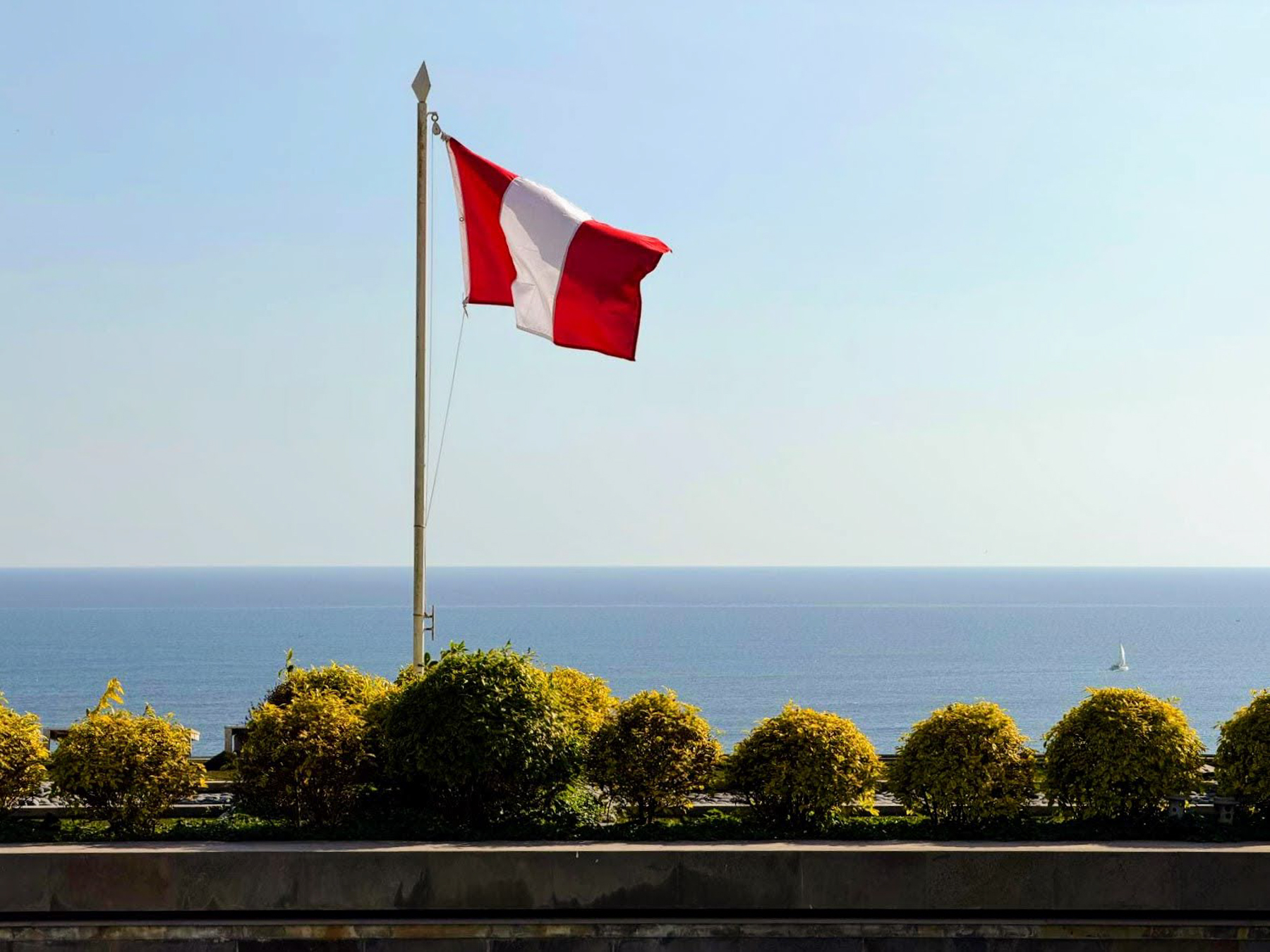
National Pride, by Phoebe Jeske.
The Peruvian flag snaps above Miraflores’ clifftop malecón, as the Pacific Ocean stretches behind it. Legend has it that General San Martín settled on red and white after he spotted a flock of parihuanas (flamingos with blood-red wingtips) on the coast near Pisco in 1820 and declared the flag on the spot. True or not, the legend’s focus on seabirds is fitting for a city caught between land and shore.
BY BRIAN LANGLEY
An ode to Lima, Peru—
Lima is an unstoppable, unrelenting surge of human ingenuity, desire, and chaos checked only by the one thing stronger than she—nature, specifically the Pacific Ocean.
Flowing up and out from the ancient Wari people, and the Chancay, and the Lima civilization and flowing down from the heart of Incas, these ancestors found and made communal life in the desert thanks to the rivers Chillón, Rimac, and Lurín, and the bountiful Peruvian seas fed by the Humboldt current coming north from Antarctica.
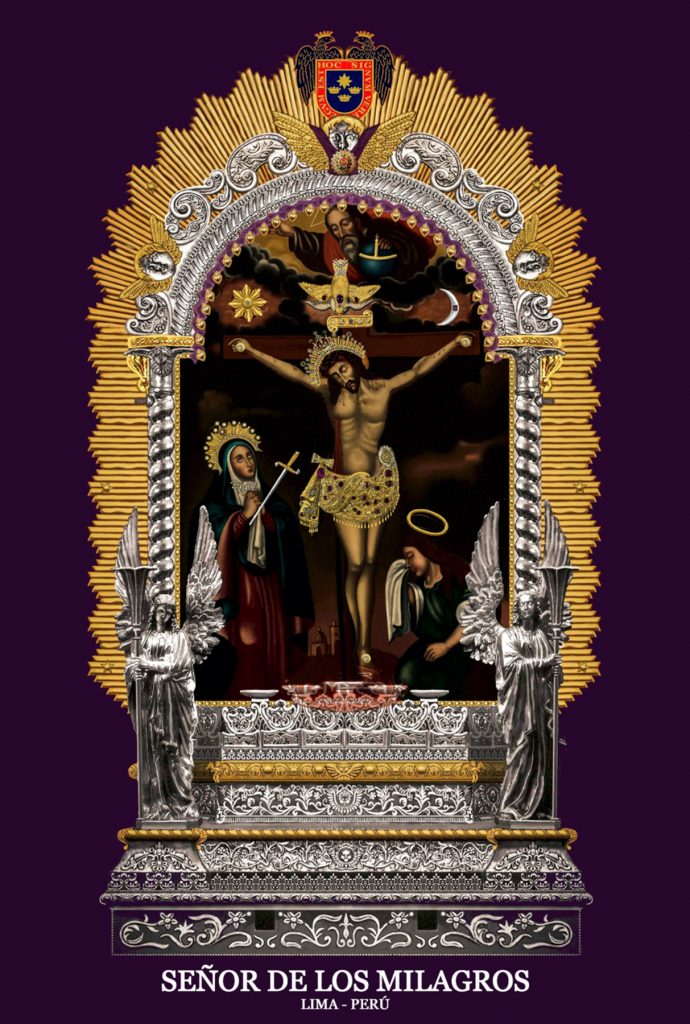
Since the time the second Jewish temple was destroyed by the Romans, the bustling port of Callao on the northwestern edge of Lima has been wafting a pungent fish smell across the bay—the boats come in, and the boats go back out across millennia. This is where La Punta extends out into the sea toward Isla San Lorenzo, and if you go across in a boat you can still see rooftops just below the surface, buried by the devastating earthquake and tsunami of 1746, estimated as one of the most powerful recorded on planet Earth to this day. But the Señor de los Milagros mural miraculously survived the destruction, and every October, thousands upon thousands walk her streets in homage to a divine power who brings us through the storm.
When the mountain rains rush down the valleys in the city, huaycos happen, and the streets flood in this desert metropolis. Millions of her inhabitants are faced with the infuriating contradiction of both too much and not enough water. The ancient residents of these foggy coastal plains found aquifers below the surface, which are still in use today. Once we lined up with all our neighbors at a municipal park to get the only fresh water available—from the indistinct, unlabeled hand pump which accessed this ancient aquifer. Somehow most of the 10 million humans sheltered here get the fresh water and food they need every day, and given everything, this feels to me like the greater miracle.
Packed in like the sardines which run abundant off her shore, this throng of humanity from all corners of the globe pretends to represent the whole of the Peruvian people, but it is only a third. Precious few locals dream of living their whole life in this city, but alas, where else can they make as much money and educate their children? Lima has been the critical mass of the hopes and dreams of Peruvians for generations, like it or not.
Lima is where I learned how to be a parent, and where I learned that some of the most interesting and intelligent people around may be struggling in grinding poverty. Lima is where I met Gustavo Gutierrez, where we rode in his Volkswagen Beetle to his humble office, and discussed God and community and poverty and a theology of liberation. Lima is where I had my panic attacks. I was living in Lima when the Twin Towers were attacked and collapsed, and we thought the world was ending. Lima is where we brought two of our children home for the first time, which was the beginning of whole new worlds for our family.
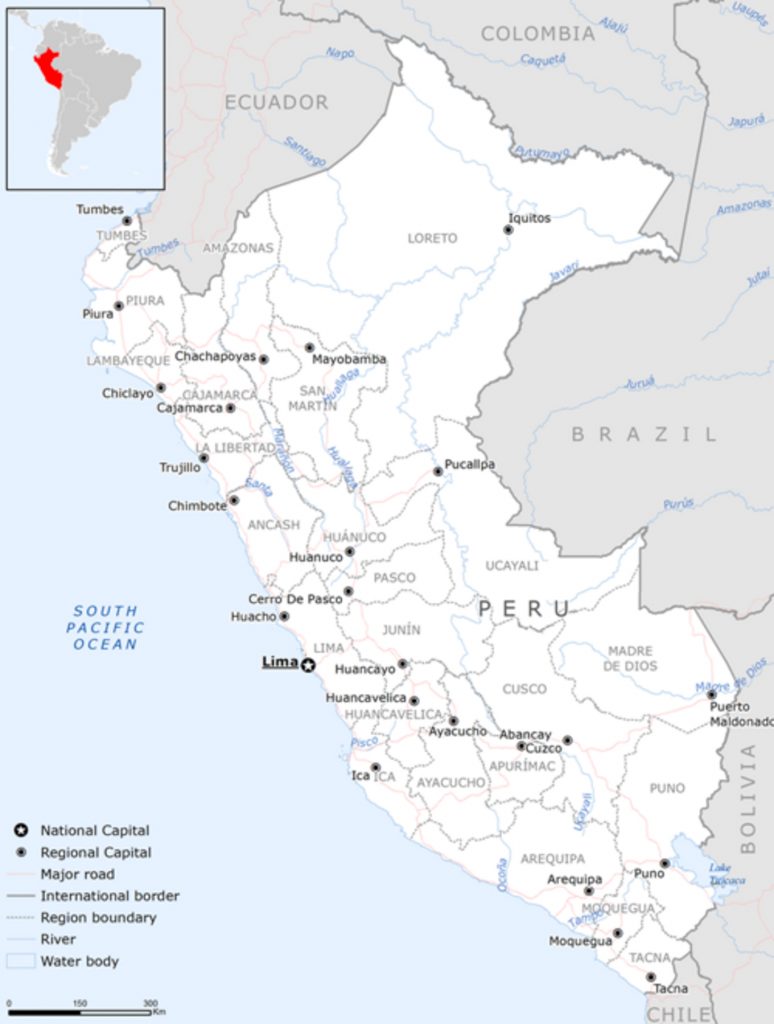


A PHOTO ESSAY COMING SOON
If you would like to visually explore the country of Peru, Phoebe Jeske’s images will take you to the Land of the Incas. Check back next week for this photo essay.
The house we lived in is still there, but the new owners painted it a different color. One of my friend’s houses is not there anymore, the spot unrecognizable due to the large building in its place. My other friend’s house is still there but almost unrecognizable due to many phases of additions. The constant low-pitched hum of fully-loaded dump trucks’ engines and tires and rusting metal sounds out on the route to the coast, seeking to claim or reclaim land from the great ocean in the name of Lima’s power. The cranes, the rocks, the dust, and the ever-present grinding and pounding starts at 7 a.m. and continues right up until 6 p.m.—or even longer, if you need to keep building, and you are willing to risk the neighbors complaining.
While running along the clifftop Malecón, I heard two men shouting obscenities at each other. They were also running, and apparently one had passed by the other in a way that inflamed the passions of both. So there they were: two men in Lima running in the same direction, yelling at each other, taunting each other, but still running. They continued this way for about 100 meters until one pulled away at a faster pace. Lima will do that to the best of us. Keep your wits and grind your calm because both will be tested to the limit.
Lima has the best restaurant in the world, but it also has an out-of-control population of feral street dogs that mostly subsist on the trash that collects on many of her streets.
Not surprisingly, I heard commentary that my Spanish, after five years since my last visit, had gotten worse, but also that my Spanish had gotten better. Some shared with me that Lima is so much better than before; others that Lima is so much worse than before. There are intersections where no driver respects the traffic signals and everyone runs through the stop sign, and others where there aren’t any traffic signals at all, and everyone seems to know what to do.
Lima will always feel like home to me, while also being a place that requires a lot of work and suffering to make a home.
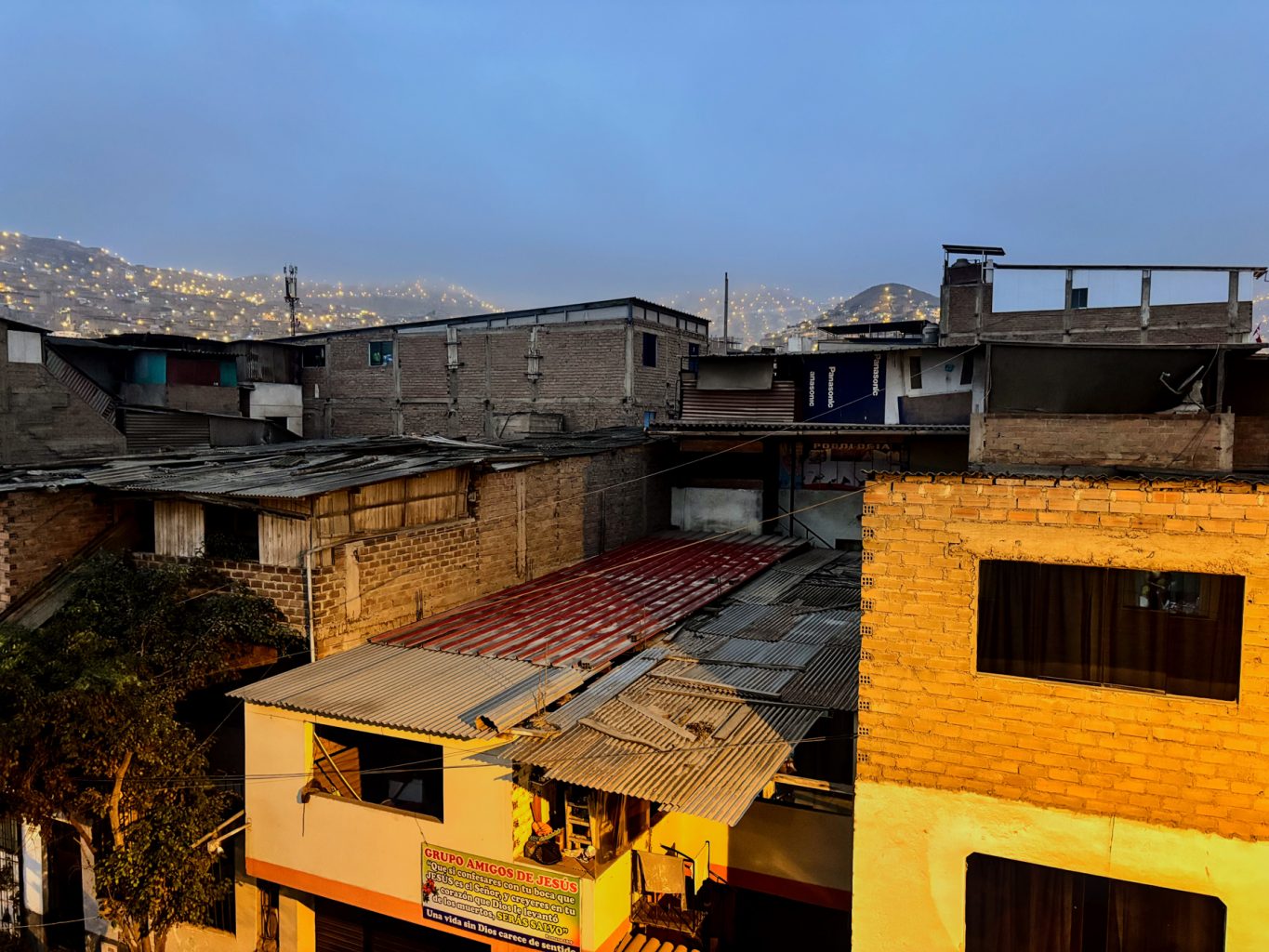
Sleeping Barrio, by Phoebe Jeske
Fog blankets multi-story homes in Pamplona Alta San Juan, Lima. Lima’s cold Humboldt Current traps moisture as fog (la garúa), not rain, and the city’s coastal desert gets less than 10 millimeters (0.4 inches) of water every year. These multi-story, multigenerational homes are common for Peru’s poorer neighborhoods. In a process called autoconstrucción, families save money and construct their homes over the course of decades.
Brian Langley
According to his mom, Brian Langley is someone who “loves to build things and take things apart.” In Peru he worked to build faith-based community projects that respond to Gustavo Gutierrez’s penetrating question, “Where will the poor sleep?” From there, he and his wife owned and operated an affordable housing business in Ohio. Next sojourn is Puerto Rico where issues of identity, history, housing, and culture are calling to him.